

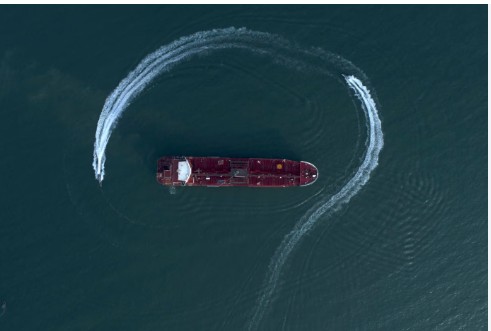
A fresh wave of debate over maritime sanctions enforcement has emerged after multiple oil tankers were observed pausing near Iranian waters, raising questions about consistency, strategy, and global compliance mechanisms.
At the center of attention are two vessels—Rich Starry and Elpis—whose movements have drawn scrutiny from analysts and policy observers alike.
Tankers’ Movements Trigger Policy Questions
The tanker Rich Starry is currently listed under a “for orders” status, indicating that it is awaiting further instructions rather than proceeding to a declared destination. Meanwhile, Elpis has remained stationary after approaching waters near Iran.
These developments have intensified concerns about how international sanctions are interpreted and enforced in real-world maritime scenarios, particularly in sensitive regions tied to global energy supply.
Enforcement Not Uniform, Say Experts
According to Charlie Brown from United Against Nuclear Iran, sanctions enforcement at sea is far from consistent.
He noted that enforcement often depends on:
- Strategic geopolitical priorities
- Diplomatic considerations
- Operational feasibility in high-risk zones
This uneven application creates a complex environment where shipping companies must navigate not only commercial risks but also regulatory ambiguity.
Grey Zones in Maritime Sanctions
The situation highlights the existence of “grey zones” in global sanctions regimes, where legal frameworks may be clear on paper but difficult to implement uniformly across international waters.
Key challenges include:
- Monitoring vessel movements in real time
- Determining compliance amid shifting cargo and ownership structures
- Balancing enforcement with broader geopolitical stability
The presence of vessels like Elpis near Iranian waters has once again underscored how maritime trade routes can become focal points of geopolitical tension.
Implications for Global Shipping and Energy Markets
The uncertainty surrounding enforcement is likely to have broader consequences:
- Increased insurance premiums for vessels operating in high-risk zones
- Greater reliance on flexible routing strategies
- Potential disruptions in global oil supply chains
Shipping companies are increasingly adopting a cautious stance, often delaying decisions until there is greater clarity on both market conditions and regulatory risks.
A Growing Need for Clarity
As tankers such as Rich Starry and Elpis remain in holding patterns, the episode underscores a broader issue: the need for more transparent and coordinated global enforcement mechanisms.
Until then, maritime operators are likely to continue navigating a landscape defined by uncertainty, strategic calculation, and evolving geopolitical realities.